Wednesday, 8 August 2018

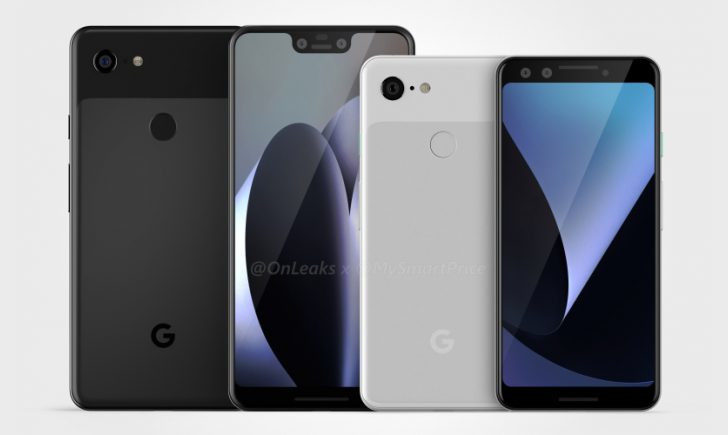
Google Pixel 3 XL leak appears to show production hardware and wired USB-C Pixel Buds

Is Google actually including headphones in the box this time?

By Chaim Gartenberg on August 8, 2018 9:10 am


Photo: Канал Лучкова (via Android Police)

We’re still presumably months away from the official Pixel 3 and Pixel 3 XL announcement, but that isn’t stopping the leakers. The latest images of Google’s next flagship appear to show finalized production hardware and what seems to be a pair of wired USB-C Pixel Buds.

The pictures come from Russian tech blogger Канал Лучкова’s Telegram channel (via Android Police), and they’re in line with earlier images we saw from other Pixel 3 XL leaks, including the already controversial notch. In these admittedly less-than-ideal shots, it appears to be a bit deeper than some users would like. (The Verge’s resident notch expert, Vlad Savov, commented that he finds it to be “the worst of all the notches so far.”) This time, the engineering emblem on the back seen in prior leaks has been replaced by Google’s G logo, so the phone has seemingly moved much closer to final production.

Photo: Канал Лучкова (via Android Police)

Also in the leaks are images of what looks like a bundled pair of wired USB-C headphones that Google might include in the box with the Pixel 3 line. Back when the Pixel 2 first launched, there was considerable evidence that Google was working on a wired version of its Pixel Bud headphones to ship with the phone. There was even an early packaging design that had a slot for the headphones, and it outright mentioned them in the manual.

Instead, Google only included a USB-C to 3.5mm dongle, much to the frustration of users who had to deal with the incredibly poor offerings of USB-C headphones on the market. If the leak is to be believed, the Pixel 3 won’t force users to deal with that issue again.

Photo: Канал Лучкова (via Android Police)

Google is expected to announce the Pixel 3 and Pixel 3 XL sometime in early October, if previous launches are anything to go by. But at the current pace of these leaks, there might not be anything new left to share by then.

Sunday, 5 August 2018

Stock Android vs Android One vs Android Go: Which Android Is Best For You?


2 weeks ago

Android Oreo vs Android One vs Android Go

Android has probably more versions than Indian spices in Sundar Pichai’s house. From Android Cupcake that came out in 2009 to Android Oreo, the platform has deeply ingrained in our lives. And just when people were content with the long overdue update of Android Oreo 8.1, Google seems ready with Android Pwhich is only a few months away from its global release.

But if these are considered to be the dominant Android versions, where do Android One and Android Go fit in? Well for starters, both of them are merely variations of Pure Android experience (Stock Android) which you see in Pixel devices or others.

A Little Backstory…

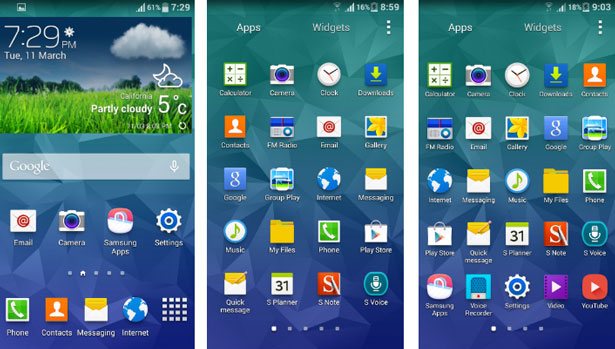
Samsung TouchWiz

Traditionally, things have been working differently.

Google would publish its source code for the latest Android version,OEMs like Samsung, Huawei, HTC pick up that codeMake a few adjustments, wrap it up in a nice package (Samsung Touch Wiz, HTC Sense, etc.)And roll out the customized version globally

But modification of the stock Android bring some challenges for users: sluggish performance, update delays, security lapses and many more. Many UI even fails at aesthetics too.

So, Google came out with its own variations, namely Android One and Android Go Edition, so that people with lower-end phones can have a Pixel-like user experience.

Let’s check out every variation and see which one should be your choice:

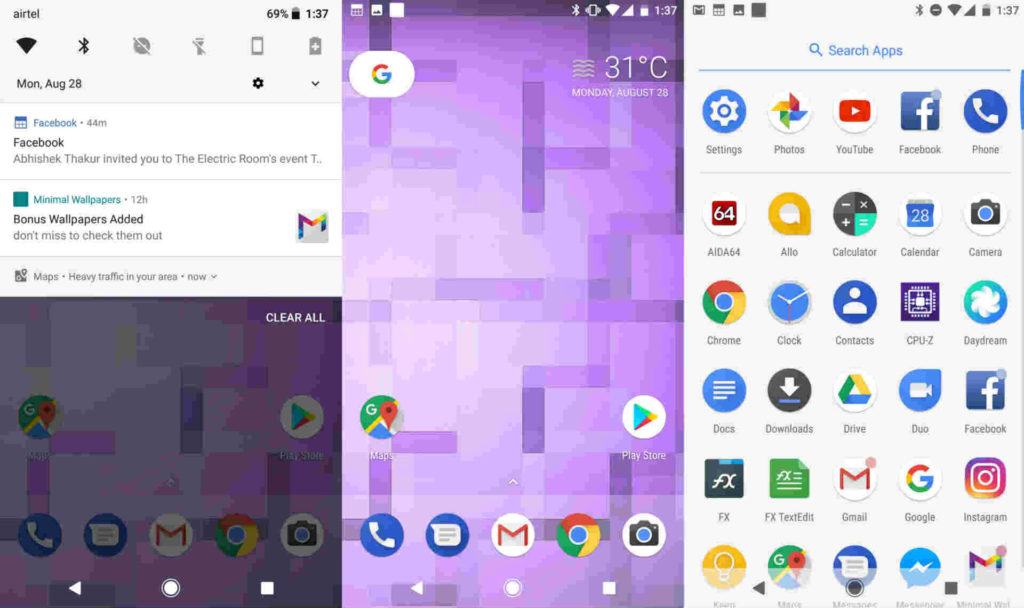
Stock Android (Android Oreo)

Source: Techook

Android Oreo (8.0) was the next version in line after Android Nougat. It came out in early 2017 initially releasing on Nexus and first-generation Pixel devices. However, 30 percent of Android users still use Nougat.

Being the primary version of Android, it is entirely backed up with latest updates and security patches. The sole reason why it is called Stock Android is that it gets total support from Google.

Salient features of Android Oreo (Stock Android)

Google Daydream

Google Daydream turns your smartphone into a Virtual Reality (VR) friendly device. You can play VR games, YouTube videos, etc. Google daydream is only available on a few high-end devices like Pixel, Galaxy S9, and LG V30, etc.

Picture–in–Picture

The feature makes it easy to switch between apps which retaining the previous app on the screen. The applications shrink into a floating widget when pressed Home button.

Notification dots

The notification dot halves the stress of opening the apps to see any new notification. The notification dots feature puts a little dot over the app’s icon.

Password Autofill

Password autofill is similar to Chrome autofill; only it works for all android apps.

Stock Android is used by Google manufactured devices like Pixel series and previous Nexus devices. Other than that, nearly all major companies like Samsung, Asus, Lenovo, and Huawei use modified versions of Oreo on their devices.

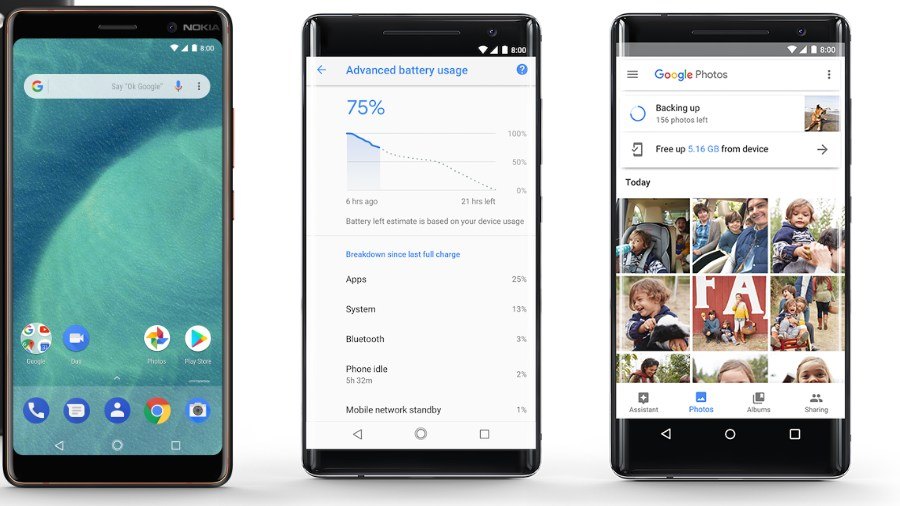
Android One

Android One on Nokia

Android One was launched in 2014 to target the entry-level devices that can deliver the pure android experience. But it has exponentially grown into a massive parallel project by Google.

The Android One gives stock Android experience to people with cheap and mid-range phones, rather than people buying premium devices

Salient features of Android One:

Fast Android OS updatesSecurity Updates for three years.Optimized Google AssistantPure Stock Android experienceGoogle Play ProtectNo bloatware (pre-installed apps from manufactures)

A significant difference between Stock Android (Oreo) and Android One is that it is not available on AOSP. Google personally hands out Android One to brands in collaboration, limiting bloatware and unnecessary skins.

List of devices that support Android One:

Nokia (8 Sirocco,7 Plus, 6)Xiaomi (Mi A1)General Mobile (GM8, GM6, GM5, GM5+)Ymobile (S1, S2, X1)Moto X4HTC U11 Life.

Android Go

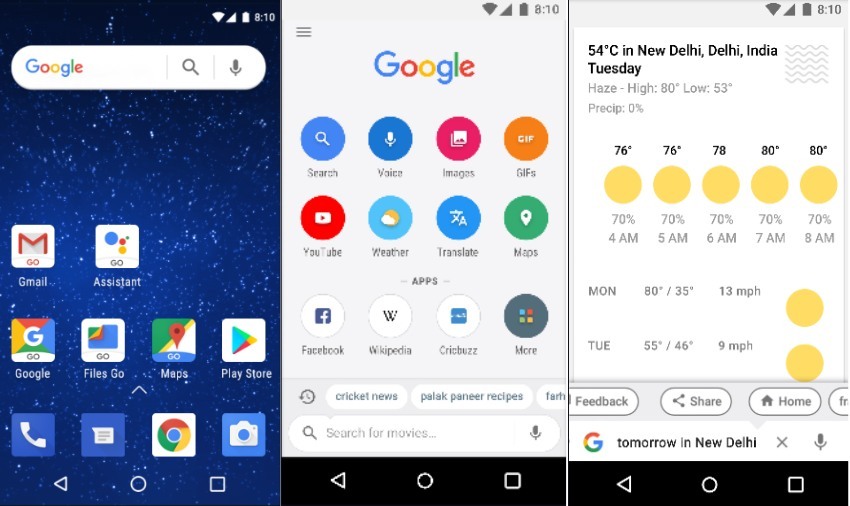
Android GO

Android Go a.k.a Oreo GO edition moves ahead with the vision of Android One. It is a lightweight platform targeted explicitly at lower-end devices. The target here is to provide Android experience to devices with poor specifications.

Salient features of Android Go

More Storage

The operating system is optimized to run on devices with 512 MB or 1GB RAM. The software takes shallow storage on Android Go devices to provide a smooth experience.

Data Saver

The feature restricts background apps to consume mobile data.

Google Apps

Google has also developed a few stripped down versions of Google Apps. These are lightweight apps ranging from 5MB – 10MB. Youtube, Chrome, Gmail, Gboad, Play Store, Google Assistant, Files are few apps which have been customized for Android GO phones.

The downside of using Android Go is that the GO apps compromise on features to justify the low storage.

The big difference between Android Go and the other two is Google does not play any role in updates or security. Although Google offers it to manufactures, the responsibility of updates and upgrades is in the hands of OEMs.

While Andoird One is inclining towards mid-range devices, Android Go focus is only on cheap handsets.

List of devices that support Android GO:

Alcatel 1XNokia 1General Mobile GM 8 GoLAVA Z50ZTE Weather GoMicromax BHARAT GO

Which Android is best for you? Stock or Go or One?

Well, it depends.

If you are looking for Android experience but are very low on budget, Android GO is for you. But keep note that Android GO receive security and software upgrades from the OEMs like Samsung and not from Google. So you may see some updates running late in future.

Let’s say you want a Pixel but that would dig deep in the pockets. Then you should go for Android One smartphones. They give the same Android experience. Everything is same just the responsibly of giving away “untouched” Google updates is in the hands of OEM.

And if want to remain connected with Google all the time – go for Stock Android. Get timely updates and assistance from Google itself.

Did you find this Stock Android vs Android One vs Android Go comparison helpful? Share your views and keep reading Fossbytes.

Unpacking Google’s role in Android One — Is this the new Nexus line?

We’re hot off the heels of the launch of Xiaomi’s Mi A2 — an Android One device that makes us pretty excited for the future of the platform. The thing is, a lot of people are still pretty confused about what Android One is, exactly. Is it a product? A platform? Both?

We decided to go straight to the source, so we sat down with Google’s Director of Android Partner Programs Jon Gold to talk about Android One and Google’s role in the initiative.

What even is Android One, anyways?

ALSO READ

Graduating class: Nexus – Pixel – Android One – Android Go

If you’re wondering, Android One is not a forked version of the platform. This is still core Android, but Google is working extremely closely with a few select manufacturers to produce its vision for Android on third-party hardware. There aren’t any core software differences from your run-of-the-mill Android device, but you get the assurance Google put in the extra effort to make sure an Android One device works and runs almost as smoothly as its own Pixel phones.

This kind of sounds like a certification, right? Google takes a phone and performs its own tests, then works closely with the manufacturer to provide an experience it is proud to stick its brand on. While this true to an extent, Google really wants users to think of Android One as a product — one they can purchase and feel confident that Google has taken the time to optimize.

During my interview with Gold, he told me Google really wants users to see Android One as a trusted product from Google. If they can’t completely control the hardware and software, working closely with the manufacturers to hit certain quality standards is the next best thing.

Android One is a curated portfolio of select devices that we think are right.

Jon Gold - Director of Android partner programs at Google


Unfortunately for smaller manufactures, getting your phone into the program isn’t exactly easy. Gold told me Google selects Android One manufacturers very carefully, so you’ll have to get Google’s attention before they’ll start working with you to optimize your device. This has lead Google to work directly with companies that have shown rapid growth like Xiaomi, making the Android One branding both lucrative as well as a symbol of success.

From my point of view, this is all about expanding Google’s vision for Android around the world. The more popular Android One devices become, the more companies will be clamoring for the opportunity to work with Google on a phone. This leads to a bunch of pseudo-Pixels populating the landscape, where Google’s own apps and software will work best.

It’s a win-win for both players in the partnership. A company like Xiaomi gets to work directly with the developer of Android itself, and Google gets to insist that companies use its own services. Most people prefer Google services over third-party options as it is, but Google is still a software company at the core, and getting more users onboard with its vision for the platform is its primary goal.

Optimized doesn’t have to mean budget

There seems to be a mindset that Android One devices are supposed to be budget phones. This is an understandable misconception based on existing devices in the lineup, with premium devices like the Nokia 8 Sirocco being obvious outliers. When I mentioned this, Gold brought up the respectable specs present in some of the Android One devices, even if they aren’t considered “flagships.”

“[The Mi A1] has 4 gigs of RAM, 64 gigs of ROM and has a 600 series chipset in it. Just because it costs $230 doesn’t mean that it’s necessarily not high performance.”

Still, we’ve seen first hand that specs aren’t everything. The Google Pixel 2, with its now slightly outdated QualcommSnapdragon 835 still feels smoother than a lot of 845-enabled devices on the market. A lot of that is due to optimization — the same optimization Google is trying to plant in Android One devices.

FURTHER READING

The smoother Google can make its own Android experience, the more likely users will start to see Android as a viable option. Many people still see Android as the buggy, janky alternative to the iPhone. If Google can’t control the experience coming from various manufacturers, this muddies the public perception of Android as a whole. By offering Android One as an approved product with Google’s name on it, Google is guaranteeing customers a phone tested with the same scrutiny as its own devices.

Look at the newly released Xiaomi Mi A2. This is obviously an ultra-affordable device at 250 euros (~$290), but the camera has already been hailed as exceptional for its price point. Who arguably makes the best camera on the market driven primarily by software? That would be Google.

I reached out to Google after the interview to ask how much influence it had on the development of the Mi A2’s camera, and got this response:

We don’t have a comment on this particular device/camera, but in general, we do a lot of internal testing (including “dogfooding”) and tackle bugs together with our partners. We do believe camera is a very important feature for many smartphone users, so it’s definitely one aspect that we focus on when working with partners to deliver a high quality experience.


Google obviously understands what makes a phone desirable to the user, so they likely put a lot of work in to make sure the camera was killer on this phone. The camera was one of the Pixel’s main selling points, so keeping the quality consistent on a phone with Google’s vision for Android only makes sense.

Nexus, Play Edition, or something else entirely?

These partnerships effectively make Android One an evolution of the long-gone Nexus line. Gold told me manufacturers are still very interested in working directly with Google to optimize their devices. Android One is a great way to let them do that, and it allows Google to maintain control of the quality and experience. If you can control the entire stack of software and hardware, it is much easier to develop a great experience.

We’ve seen a similar program come and go before. Google Play edition devices effectively slapped “stock” (our word, not Gold’s) Android on existing devices to satisfy a subset of users, but Google was much less involved in this process. Where One devices are really made with the Google experience in mind from the beginning, Play Edition phones shipped as a special variant with Google software. You have to design a device completely differently if Google’s working alongside you, and many manufacturers are happy to oblige.

“I see [Android One] as an evolution of [Nexus] rather than an evolution of Play Edition. Play Edition was too much of a one off. There was too much of a ‘Just take this and slap the experience on a device’,” says Gold.

Obviously, Gold sees the program as something Google is ready to invest in full stop. There are currently sixteen Android One devices available on the market, but Gold told me we can expect a number of new One devices to launch in 2018, with even more coming in 2019 as the program matures. Google hasn’t mentioned what manufacturers it will be working with during this period, but we can likely expect a few more mainstream players will join the pack as the the initiative moves forward.

What are your thoughts on Android One?

Let us know.

Google may have revealed the Pixel 3's announcement date


Ryne Hager


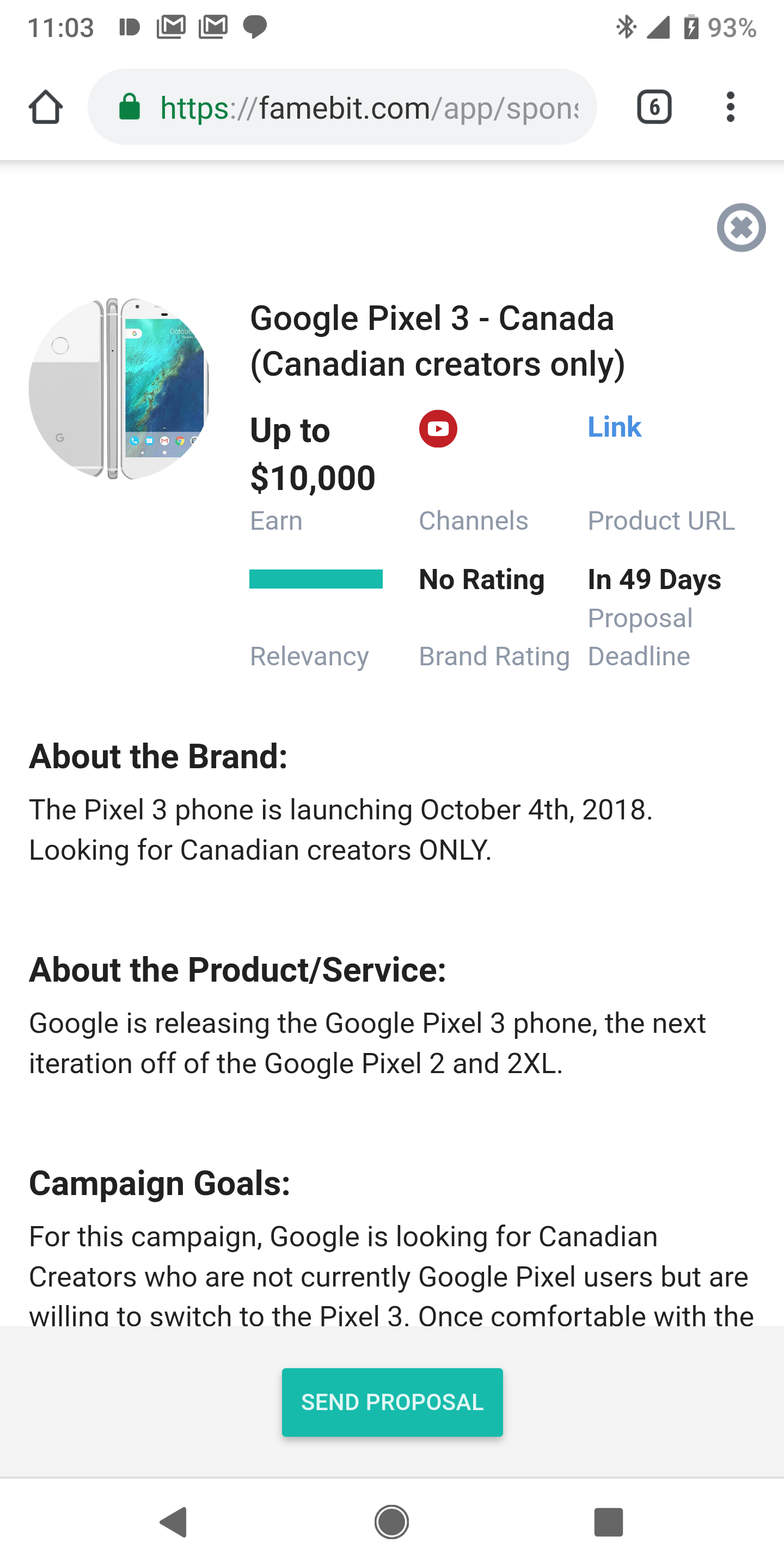
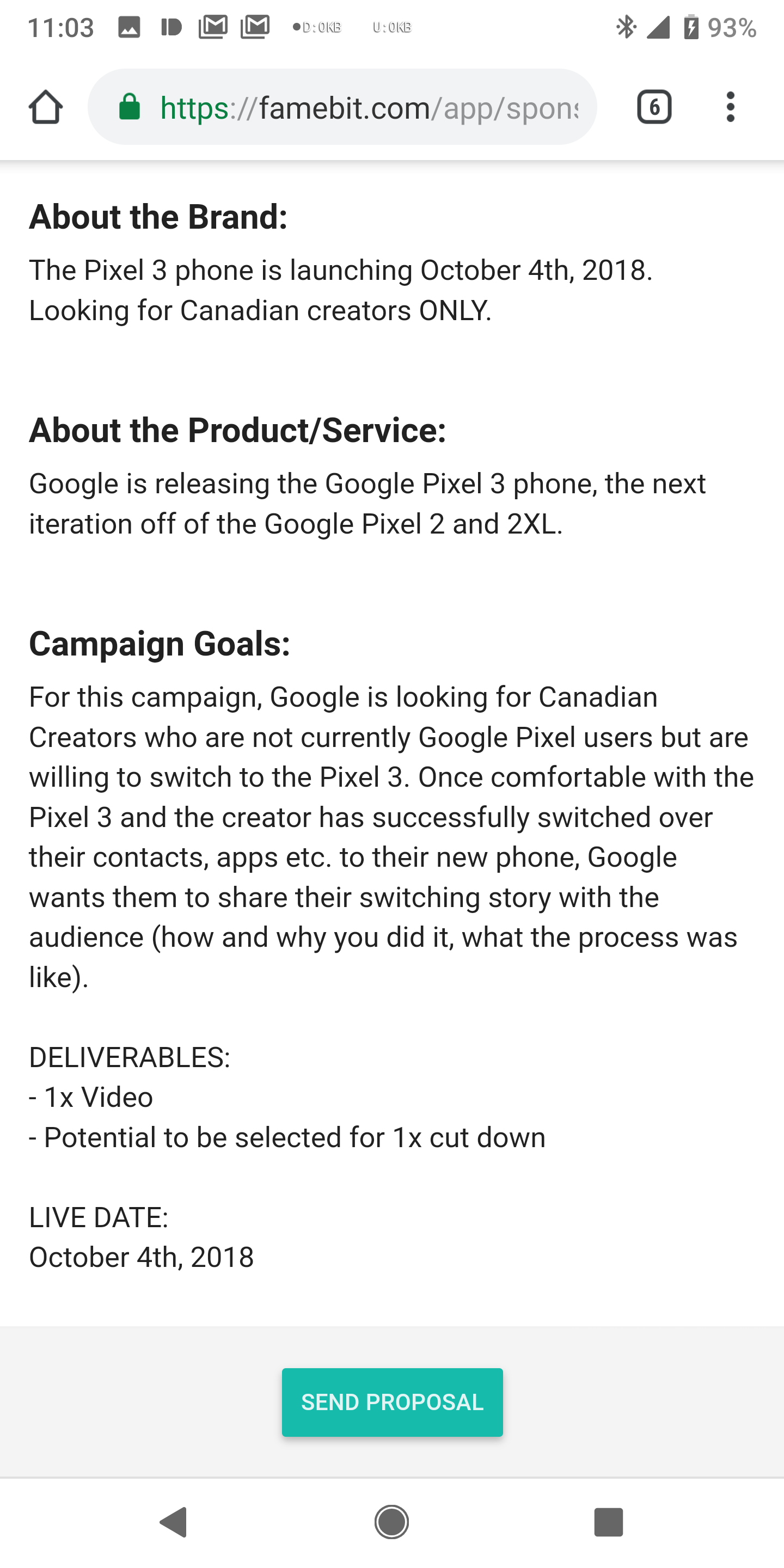
We were able to access the listing for ourselves on Famebit and confirm that it exists. Our article has been updated with screenshots and that confirmation.

In a surprising twist, it appears Google may have accidentally let slip the date that the Pixel 3 is set to be formally revealed. Brandon Lee of This is Tech Today—who also makes videos for Android Police—has spotted an ad posted by Google on its own Famebit site that implies the phone is going to be formally revealed on or by October 4th.

For the unfamiliar, Famebit works to connect advertising agencies and marketers with content creators to coordinate promotional material, influencing so-called "influencers" for the purposes of sponsored content. In this case, the posted ad was allegedly created by Google itself to promote the Pixel 3 in Canada, with a description that notes, "The Pixel 3 Phone is launching October 4th, 2018."

That date lines up historically with previous Pixel announcements, which have all been revealed by Google at its now typical "Made by Google" October 4th event. Historically, Google hasn't actually shipped devices at that announcement, and although the listing does state that's when the phone will "launch," the word hasn't always been synonymous with actual availability.

Now, it's possible that this ad may not have been legitimately created by Google. Although we were able to access the listing ourselves, we can't verify if Google is, indeed, the author behind the posting. It's possible this could be an elaborate hoax, but we don't think that's too likely. Google has been consistent with these dates for several years, and the strange specifics in the ad itself add some credibility, implying some poor employee in a Canadian arm of Google's marketing department just didn't pay attention.


Either way, we'll know one way or the other in precisely two months.

Thursday, 2 August 2018

Huawei Mate 20 rumors: Release date, specs, price, and features!

Huawei's next flagship family is looking awfully exciting.

1 Aug 2018 7

It can be difficult to keep up with all the phones Huawei releases over the course of a year, but one that continues to stand out from the pack is the Mate 10 Pro.

The Mate 10 Pro is a gorgeous and powerful piece of tech that made a splash in various countries but was unfortunately held back from greatness in the U.S. thanks to continuous pushback from the government.

Huawei's expected to follow-up on the Mate 10 Pro's greatness with the Mate 20 Pro and two other versions to accompany it, and even if it once again gets heat from the States, it'll still likely be one of the best phones you can get early next year.

The latest Mate 20 news

August 1, 2018 — Leaked firmware suggests the Mate 20 will ship with Android P, have a 4,200 mAh battery, and use the Kirin 980

We're likely a couple months out from an official announcement from Huawei regarding its Mate 20 phones, and just in time, the rumor mill has kicked into full gear with a ton of info that was recently shared in firmware files obtained by XDA Developers. The files outline three phones — the Mate 20 Lite, Mate 20, and Mate 20 Pro — but focuses mostly on the mid-tier option

The Huawei Mate 20 will reportedly ship with a large 6.3-inch OLED display, and as expected, use Huawei's next-generation Kirin 980 processor. To accompany this, we're expecting 6GB RAM, 128GB of internal storage, and a seriously huge 4,200 mAh battery.

And, to help you charge that battery pack, Huawei is finally going to jump on board the wireless charging train.

Not much is detailed about the other two phones, but there is mention of the Mate 20 Pro including an in-display fingerprint sensor similar to what we've seen on the Mate RS and Vivo X21.

All three phones will likely ship with Android P and Huawei's EMUI 9.0 skin on top of it.

All the big details

How many phones will there be?

Similar to last year, we're expecting three different versions of the Mate 20 family — including the Mate 20, Mate 20 Lite, and Mate 20 Pro.

The Mate 20 will be the mid-tier option, whereas the Mate 20 Lite is the most affordable and the Mate 20 Pro is the most expensive/powerful.

If Huawei follows a similar launch pattern compared to the Mate 10, we'll only get the Mate 20 Pro in the U.S.

How much will the Mate 20 cost?

Before we can speculate about how much the Mate 20 family will cost, we need to first look at last year's pricing.

Huawei Mate 10 Lite — £280Huawei Mate 10 — £699Huawei Mate 10 Pro — £799

The Mate 10 Pro started off with a $799.99 price in the U.S., but right now, can be purchased on Amazon directly from Huawei for just $549.99.

I expect we'll see similar pricing for the Mate 20 lineup, with an increase of £20 - £50 here or there thanks to the rumors of a 4,200 mAh battery and in-display fingerprint sensor.

When will it be released?

As for when we'll be introduced to the Mate 20 series for the first time, we're likely looking at an announcement within the next couple of months.

The Huawei Mate 10 family was announced on October 16, and a year before that, the Mate 9 was unveiled on November 24.

Wednesday, 1 August 2018

Huawei’s New 7-inch Phone Is Absolutely Massive


Huawei is working on delivering one of the largest smartphones in the world with a new handset under its Honor brand.

Credit: Honor Original Image

The newly unveiled Honor Note 10 boasts a 6.95-inch AMOLED screen, making it substantially larger than the top smartphones on the market today. The iPhone X, for instance, comes with a 5.8-inch screen. The Galaxy Note 8, which has a stylus and is designed to be a leader in the phablet market, only comes with a 6.3-inch screen.

The nearly 7-inch screen in the Note 10comes with a resolution of 2220 x 1080, according to BGR. Inside, the smartphone comes with an octa-core Kirin 970 processor and uses Huawei's GPU Turbo for graphics performance. A listing on the company's website says there will be three Note 10 variants. The first and cheapest will offer 6GB of RAM and 64GB of storage. The midrange will offer 6GB of RAM and come with 128GB of storage. The third and most expensive version will up that RAM to 8GB with 128GB of storage.

The phone itself comes with an all-screen design that leaves thin bezels at the top and bottom. There's a front-facing camera and earpiece at the top of the screen and thankfully, there's no notch. The smartphone, which is made from glass, has a physical fingerprint sensor on the back. There's also a vertically aligned dual-lens camera that has 24- and 16-megapixel sensors (the front-facing selfie camera has a 13-megapixel sensor). According to BGR, the smartphone runs on a 5,000mAh battery and Android 8.1 Oreo.

Arguably the Honor Note 10's most appealing feature is its price. According to a listing on the company's website, the cheapest option will go for 2,799 yuan, or about $410. Bumping your choice to the 128GB options will increase the price by 400 yuan, or about $60. So, for under $500, you could get your hands on what promises to be one of the largest and most capable smartphones on the market.

Facebook is making its first serious move to monetize WhatsApp

Ads that link Facebook users to WhatsApp


Photo by Amelia Holowaty Krales / The Verge

Facebook is getting serious about monetizing WhatsApp after the social network reported sluggish earnings growth last Wednesday. WhatsApp has rolled out three new ways for customers to connect quickly with businesses: a shortcut button to immediately start a conversation, the ability to have businesses send you information like a boarding pass on WhatsApp, and real-time support, the company said today.

At the same time, Facebook will nowdisplay ads of businesses that link out to WhatsApp. That means that businesses can purchase ads that lead people directly to an already loaded chat with the business on WhatsApp, and they can start talking from there. Businesses can respond to customers for free if they answer within 24 hours but Facebook will charge them for any response after 24 hours. It looks to be another way for Facebook to cash in on its many apps.

WHATSAPP’S MESSAGING FEATURE IS NEARLY IDENTICAL TO ONE ALREADY FOUND ON MESSENGER

The message function on WhatsApp is nearly identical to the one on Facebook, where you can go to a business’s page and send a message. Business communications on Messenger haven’t been super successful to begin with, and Facebook has had to roll out additionalchat extensions to compensate. The WhatsApp blog post indicates that it’s up to the business if it wants to offer real-time support, so there could be the additional wrinkle that you might not hear back for a while.

WhatsApp opened up its platform to business users last September. Since then, it has kept the number of businesses using the app undisclosed. It said it tested the new messaging tools with about 90 businesses including Uber, Wish, and Singapore Airlines.

Today’s announcement sounds like Facebook is making new tools to entice businesses to stay on the platform as it begins to monetize WhatsApp. As additional ways to boost stagnating profits, Facebook can monetize from Instagram’s ads in Stories, for instance, and also potentially from WhatsApp businesses that are taking out ads.

GOOGLE'S HUMAN-SOUNDING PHONE BOT COMES TO THE PIXEL

COMES TO THE PIXEL ALYSSA WALKER; GETTY IMAGES/JONATHAN STOREY “Uhm,” said the female voice. "Can I book a table for tomorrow?" ...