Friday, 5 October 2018

Nokia 7.1 With HDR Display, Zeiss Optics, Snapdragon 636 SoC Launched: Price, Specifications, Features


Nokia 7.1 price starts at a global average of EUR 319 (roughly Rs. 27,000)

HIGHLIGHTS

1)Nokia 7.1 has been launched in London

2)Nokia 7.1 price starts at a global average of EUR 319

3)It will be upgraded to Android Pie next month

Nokia 7.1 is the latest offering from Nokia brand licensee HMD Global. Successor to last year’s Nokia 7, the Nokia 7.1 was launched at an event in London on Thursday. Key highlights of the smartphone include a 19:9 PureDisplay with HDR support a notch up top, a Snapdragon 636 SoC, fast charging USB Type-C, dual rear camera setup with Zeiss optics, and an Android Pie upgrade coming next month. The Nokia 7.1 is also part of the Android Enterprise Recommended range, which ensures that the phone will receive monthly security updates within 90 days of release, for a minimum of three years.

Nokia 7.1 price and release date

Nokia 7.1 price ranges from EUR 299 (roughly Rs. 24,400) to EUR 349 (roughly Rs. 29,500), depending on the region. The phone will be sold in Gloss Midnight Blue and Gloss Steel colour options, across global markets, starting October this year. India pricing and availability will be announced later.

The company also announced the launch of two new audio accessories with the Nokia 7.1 - the Nokia True Wireless Earbuds and the Nokia Pro Wireless Earphones. The former comes with up to 3.5 hours play time and a charging case with three times the charge. The latter sports a neckband with up to 10 hours of playback time. 

Nokia 7.1 specifications

The dual-SIM (Nano) Nokia 7.1 runs Android Oreo, based on the Android One programme, with an upgrade to Android 9.0 Pie slated for next month. It sports a 5.84-inch full-HD+ (1080x2280 pixels) PureDisplay panel with a 19:9 aspect ratio, HDR10 support, and Corning Gorilla Glass 3 protection. The handset is powered by a Qualcomm Snapdragon 636 SoC, paired with 3GB/ 4GB of RAM and 32GB/ 64GB of inbuilt storage.

In terms of optics, the Nokia 7.1 bears a vertically aligned pair of dual rear camera setup that consists of a 12-megapixel primary sensor, with autofocus and f/1.8 aperture, and a 5-megapixel secondary sensor with fixed focus and f/2.4 aperture. The company is also touting two-phase detection and Zeiss optics for the rear camera setup, apart from EIS. On the front, the handset sports an 8-megapixel fixed focus sensor with f/2.0 aperture and 84-degree field-of-view. There is a 3,060mAh non-removable battery under the hood with 18W fast charging, delivering 50 percent charge in 30 minutes.

Connectivity options on the Nokia 7.1 include 4G LTE, Wi-Fi 802.11ac, Bluetooth v5.0, GPS/ A-GPS, GLONASS, NFC, USB Type-C, and a 3.5mm headphone jack. Sensors onboard the smartphone include accelerometer, ambient light sensor, electronic compass, gyroscope, proximity sensor, and a rear-mounted fingerprint sensor. Dimensions are 149.7x71.19x7.99mm and weight is 159 grams.

The Nokia 7.1's dual rear cameras and Zeiss branding can be see

Juho Sarvikas, Chief Product Officer, HMD Global commented on the launch, "We believe the best camera is the one you carry with you, so we’ve designed a new imaging experience powered by ZEISS Optics, featuring rapid auto focus thanks to the two-phase detection technology to capture your own incredible HDR photography. We are excited to deliver a unique, premium experience in collaboration with best in class partners to deliver a standout smartphone at great value."

Sarvikas also touted the Nokia 7.1's real-time SDR to HDR conversion using a 16-bit engine, letting users experience "HDR quality entertainment, even when the content is not." The smartphone is built out of 6000 series aluminium CNC machined frame and a die cast metal centre.

Nokia 7.1

KEY SPECS

Display

5.84-inch

Processor

1.8GHz octa-core

Front Camera

8-megapixel

Resolution

1080x2280 pixels

RAM

3GB

OS

Android 8.1

Storage

32GB

Rear Camera

12-megapixel + 5-megapixel

Battery Capacity

3060mAh

Thursday, 4 October 2018

These new Nokia headphones are waterproof wireless earbuds with built-in vibration


Image: Nokia

HMD Global, the company that releases Nokia smartphones, announced its new flagship product today, the Nokia 7.1, and along with it, two new accessories: True Wireless earbuds and the Nokia Pro Wireless Earphones.

The Nokia True Wireless Earbuds provide up to 3.5 hours of use time, are waterproof, and come with a case that can charge the earbuds up to three times (for a total of 16 hours of play time). The Pro Wireless earbuds are connected to a neckband, have up to 10 hours of use, and have a built-in vibration to alert people when a call is coming in. Both accessories can be used to take calls without your phone.

Nokia is the latest brand to hop on wireless headphones, following in the steps of other companies like AppleGoogle, and Samsung. Even Huawei announced its own true wireless FreeBuds earlier this year — that look a lot like Apple’s AirPods. According to Android Authority, the True Wireless earbuds will retail for 129 euros ($148), and the Nokia Pro Wireless Earphones for 69 euros ($79).

Monday, 1 October 2018

Some Huawei Mate 10 Pro units start receiving Android Pie

01 October 2018

Huawei teased the new EMUI 9.0 last month, and we expected the user interface, based on Android Pie, to arrive with the Huawei Mate 20 in two weeks. Yet the company has delivered a pleasant surprise and is already pushing the update to some Huawei Mate 10 Pro units - BLA-L09 and BLA-L29 versions, sold mostly in Europe.

According to our source, EMUI 9.0 brings new gesture setup for multi-task switching between apps and a new improved 2.0 version of GPU Turbo. With Android Pie promoting digital health and wellbeing the Huawei UI offers the Android Dashboard in Settings.

Other novelties include Advanced Battery with AI Support, Notch Support, Adaptive Brightness, a slight redesign of the volume slider, and of course, security improvements. The package comes in two versions for the two models - BLA-L09C432E4R1P8B108 and BLA-L29C432E4R1P8B108. You need 2.2 GB free on your internal storage to download it

Tuesday, 4 September 2018

September security patch rolling out to Pixel/Nexus devices, factory images and OTAs live

Abner Li 

- Sep. 4th 2018 10:18 am PT

Comments

After launching on the Pixel and Pixel 2 last month, Android 9 Pie is getting its first update today with the September security patch.  A number of bugs are addressed in this update including one related to poor Bluetooth audio in cars.

There are 24 issues resolved in the September security patch dated 2018-09-01 and 35 for 2018-09-05. Vulnerabilities range from high to critical, with the most severe relating to the media framework and a remote attacker possibly executing arbitrary code through a crafted file.

As usual, Google notes that there are no reports of customers being affected by these security issues. The company cited in its 2017 year in review of Android security that 30% more devices are getting patches compared to the prior year.

Meanwhile, the dedicated bulletin for Google’s phones and tablets lists 15 security fixes and 3 functional updates. Users will benefit from a Bluetooth fix that improves audio quality over car speakers.

The full download and OTA links are below. If you need help, check out our guides on how to flash a factory or OTA image.

Android 9.0

Pixel 2 XL: Android 9.0 — PPR2.180905.005 — Factory Image — OTAPixel 2: Android 9.0 —PPR2.180905.005 — Factory Image — OTAPixel XL: Android 9.0 —PPR2.180905.006, PPR2.180905.006.A1 (Verizon) — Factory Image (2) — OTA (2)Pixel: Android 9.0 —PPR2.180905.006, PPR2.180905.006.A1 (Verizon) — Factory Image (2) — OTA (2)

Android 8.1

Pixel C: Android 8.1 —OPM4.171019.021.Z1 — Factory Image — OTANexus 6P: Android 8.1 —OPM6.171019.030.K1 — Factory Image — OTANexus 5X: Android 8.1 —OPM6.171019.030.K1 — Factory Image — OTA

Wednesday, 8 August 2018

Google Pixel 3 XL leak appears to show production hardware and wired USB-C Pixel Buds

Is Google actually including headphones in the box this time?

By Chaim Gartenberg on August 8, 2018 9:10 am


Photo: Канал Лучкова (via Android Police)

We’re still presumably months away from the official Pixel 3 and Pixel 3 XL announcement, but that isn’t stopping the leakers. The latest images of Google’s next flagship appear to show finalized production hardware and what seems to be a pair of wired USB-C Pixel Buds.

The pictures come from Russian tech blogger Канал Лучкова’s Telegram channel (via Android Police), and they’re in line with earlier images we saw from other Pixel 3 XL leaks, including the already controversial notch. In these admittedly less-than-ideal shots, it appears to be a bit deeper than some users would like. (The Verge’s resident notch expert, Vlad Savov, commented that he finds it to be “the worst of all the notches so far.”) This time, the engineering emblem on the back seen in prior leaks has been replaced by Google’s G logo, so the phone has seemingly moved much closer to final production.

Photo: Канал Лучкова (via Android Police)

Also in the leaks are images of what looks like a bundled pair of wired USB-C headphones that Google might include in the box with the Pixel 3 line. Back when the Pixel 2 first launched, there was considerable evidence that Google was working on a wired version of its Pixel Bud headphones to ship with the phone. There was even an early packaging design that had a slot for the headphones, and it outright mentioned them in the manual.

Instead, Google only included a USB-C to 3.5mm dongle, much to the frustration of users who had to deal with the incredibly poor offerings of USB-C headphones on the market. If the leak is to be believed, the Pixel 3 won’t force users to deal with that issue again.

Photo: Канал Лучкова (via Android Police)

Google is expected to announce the Pixel 3 and Pixel 3 XL sometime in early October, if previous launches are anything to go by. But at the current pace of these leaks, there might not be anything new left to share by then.

Sunday, 5 August 2018

Stock Android vs Android One vs Android Go: Which Android Is Best For You?


2 weeks ago

Android Oreo vs Android One vs Android Go

Android has probably more versions than Indian spices in Sundar Pichai’s house. From Android Cupcake that came out in 2009 to Android Oreo, the platform has deeply ingrained in our lives. And just when people were content with the long overdue update of Android Oreo 8.1, Google seems ready with Android Pwhich is only a few months away from its global release.

But if these are considered to be the dominant Android versions, where do Android One and Android Go fit in? Well for starters, both of them are merely variations of Pure Android experience (Stock Android) which you see in Pixel devices or others.

A Little Backstory…

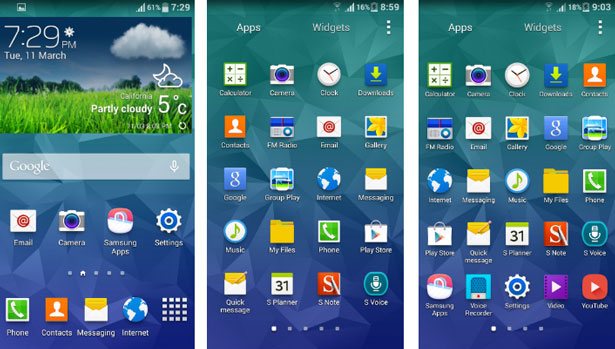
Samsung TouchWiz

Traditionally, things have been working differently.

Google would publish its source code for the latest Android version,OEMs like Samsung, Huawei, HTC pick up that codeMake a few adjustments, wrap it up in a nice package (Samsung Touch Wiz, HTC Sense, etc.)And roll out the customized version globally

But modification of the stock Android bring some challenges for users: sluggish performance, update delays, security lapses and many more. Many UI even fails at aesthetics too.

So, Google came out with its own variations, namely Android One and Android Go Edition, so that people with lower-end phones can have a Pixel-like user experience.

Let’s check out every variation and see which one should be your choice:

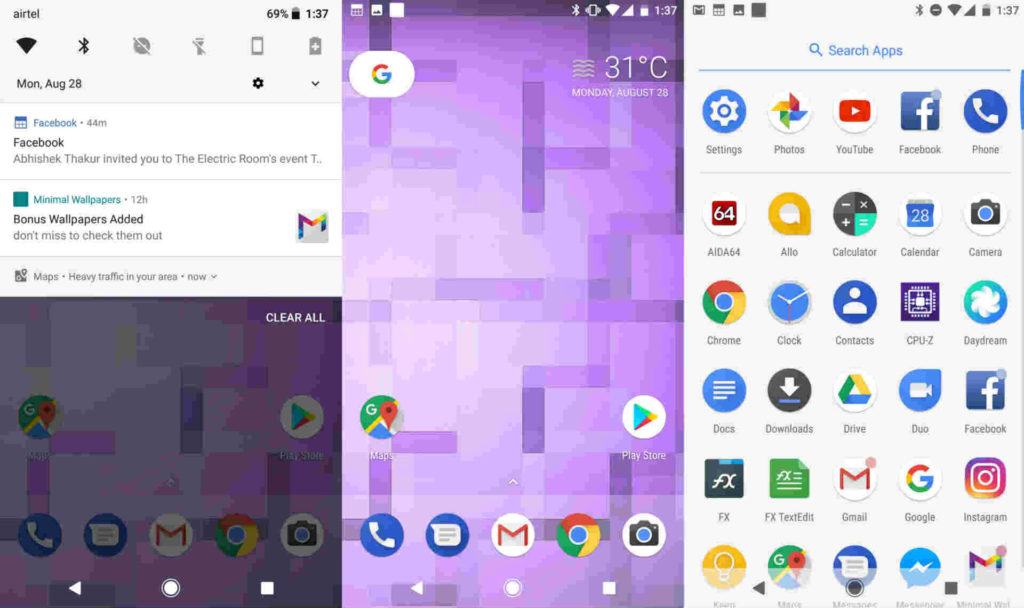
Stock Android (Android Oreo)

Source: Techook

Android Oreo (8.0) was the next version in line after Android Nougat. It came out in early 2017 initially releasing on Nexus and first-generation Pixel devices. However, 30 percent of Android users still use Nougat.

Being the primary version of Android, it is entirely backed up with latest updates and security patches. The sole reason why it is called Stock Android is that it gets total support from Google.

Salient features of Android Oreo (Stock Android)

Google Daydream

Google Daydream turns your smartphone into a Virtual Reality (VR) friendly device. You can play VR games, YouTube videos, etc. Google daydream is only available on a few high-end devices like Pixel, Galaxy S9, and LG V30, etc.

Picture–in–Picture

The feature makes it easy to switch between apps which retaining the previous app on the screen. The applications shrink into a floating widget when pressed Home button.

Notification dots

The notification dot halves the stress of opening the apps to see any new notification. The notification dots feature puts a little dot over the app’s icon.

Password Autofill

Password autofill is similar to Chrome autofill; only it works for all android apps.

Stock Android is used by Google manufactured devices like Pixel series and previous Nexus devices. Other than that, nearly all major companies like Samsung, Asus, Lenovo, and Huawei use modified versions of Oreo on their devices.

Android One

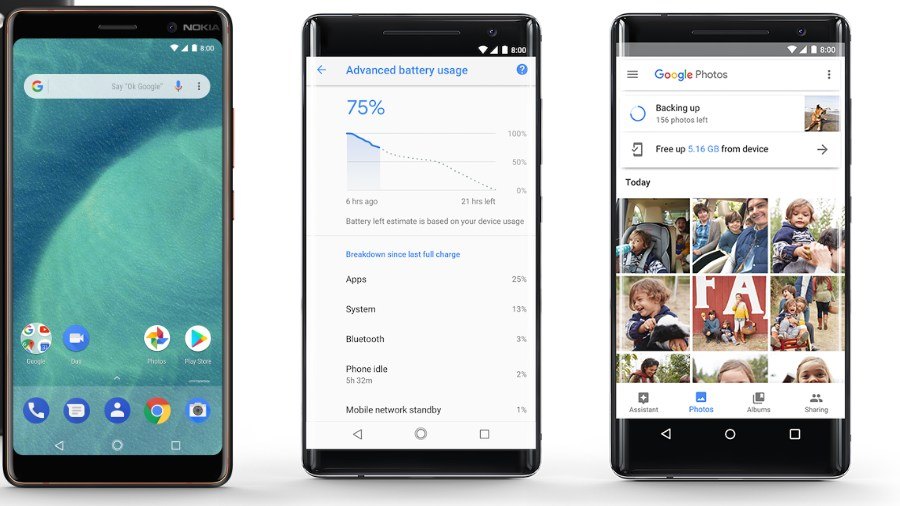
Android One on Nokia

Android One was launched in 2014 to target the entry-level devices that can deliver the pure android experience. But it has exponentially grown into a massive parallel project by Google.

The Android One gives stock Android experience to people with cheap and mid-range phones, rather than people buying premium devices

Salient features of Android One:

Fast Android OS updatesSecurity Updates for three years.Optimized Google AssistantPure Stock Android experienceGoogle Play ProtectNo bloatware (pre-installed apps from manufactures)

A significant difference between Stock Android (Oreo) and Android One is that it is not available on AOSP. Google personally hands out Android One to brands in collaboration, limiting bloatware and unnecessary skins.

List of devices that support Android One:

Nokia (8 Sirocco,7 Plus, 6)Xiaomi (Mi A1)General Mobile (GM8, GM6, GM5, GM5+)Ymobile (S1, S2, X1)Moto X4HTC U11 Life.

Android Go

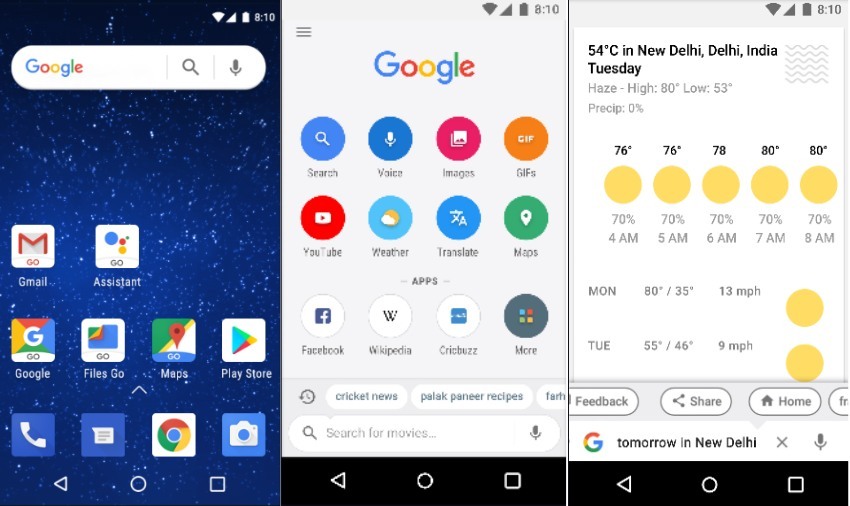
Android GO

Android Go a.k.a Oreo GO edition moves ahead with the vision of Android One. It is a lightweight platform targeted explicitly at lower-end devices. The target here is to provide Android experience to devices with poor specifications.

Salient features of Android Go

More Storage

The operating system is optimized to run on devices with 512 MB or 1GB RAM. The software takes shallow storage on Android Go devices to provide a smooth experience.

Data Saver

The feature restricts background apps to consume mobile data.

Google Apps

Google has also developed a few stripped down versions of Google Apps. These are lightweight apps ranging from 5MB – 10MB. Youtube, Chrome, Gmail, Gboad, Play Store, Google Assistant, Files are few apps which have been customized for Android GO phones.

The downside of using Android Go is that the GO apps compromise on features to justify the low storage.

The big difference between Android Go and the other two is Google does not play any role in updates or security. Although Google offers it to manufactures, the responsibility of updates and upgrades is in the hands of OEMs.

While Andoird One is inclining towards mid-range devices, Android Go focus is only on cheap handsets.

List of devices that support Android GO:

Alcatel 1XNokia 1General Mobile GM 8 GoLAVA Z50ZTE Weather GoMicromax BHARAT GO

Which Android is best for you? Stock or Go or One?

Well, it depends.

If you are looking for Android experience but are very low on budget, Android GO is for you. But keep note that Android GO receive security and software upgrades from the OEMs like Samsung and not from Google. So you may see some updates running late in future.

Let’s say you want a Pixel but that would dig deep in the pockets. Then you should go for Android One smartphones. They give the same Android experience. Everything is same just the responsibly of giving away “untouched” Google updates is in the hands of OEM.

And if want to remain connected with Google all the time – go for Stock Android. Get timely updates and assistance from Google itself.

Did you find this Stock Android vs Android One vs Android Go comparison helpful? Share your views and keep reading Fossbytes.

Unpacking Google’s role in Android One — Is this the new Nexus line?

We’re hot off the heels of the launch of Xiaomi’s Mi A2 — an Android One device that makes us pretty excited for the future of the platform. The thing is, a lot of people are still pretty confused about what Android One is, exactly. Is it a product? A platform? Both?

We decided to go straight to the source, so we sat down with Google’s Director of Android Partner Programs Jon Gold to talk about Android One and Google’s role in the initiative.

What even is Android One, anyways?

ALSO READ

Graduating class: Nexus – Pixel – Android One – Android Go

If you’re wondering, Android One is not a forked version of the platform. This is still core Android, but Google is working extremely closely with a few select manufacturers to produce its vision for Android on third-party hardware. There aren’t any core software differences from your run-of-the-mill Android device, but you get the assurance Google put in the extra effort to make sure an Android One device works and runs almost as smoothly as its own Pixel phones.

This kind of sounds like a certification, right? Google takes a phone and performs its own tests, then works closely with the manufacturer to provide an experience it is proud to stick its brand on. While this true to an extent, Google really wants users to think of Android One as a product — one they can purchase and feel confident that Google has taken the time to optimize.

During my interview with Gold, he told me Google really wants users to see Android One as a trusted product from Google. If they can’t completely control the hardware and software, working closely with the manufacturers to hit certain quality standards is the next best thing.

Android One is a curated portfolio of select devices that we think are right.

Jon Gold - Director of Android partner programs at Google


Unfortunately for smaller manufactures, getting your phone into the program isn’t exactly easy. Gold told me Google selects Android One manufacturers very carefully, so you’ll have to get Google’s attention before they’ll start working with you to optimize your device. This has lead Google to work directly with companies that have shown rapid growth like Xiaomi, making the Android One branding both lucrative as well as a symbol of success.

From my point of view, this is all about expanding Google’s vision for Android around the world. The more popular Android One devices become, the more companies will be clamoring for the opportunity to work with Google on a phone. This leads to a bunch of pseudo-Pixels populating the landscape, where Google’s own apps and software will work best.

It’s a win-win for both players in the partnership. A company like Xiaomi gets to work directly with the developer of Android itself, and Google gets to insist that companies use its own services. Most people prefer Google services over third-party options as it is, but Google is still a software company at the core, and getting more users onboard with its vision for the platform is its primary goal.

Optimized doesn’t have to mean budget

There seems to be a mindset that Android One devices are supposed to be budget phones. This is an understandable misconception based on existing devices in the lineup, with premium devices like the Nokia 8 Sirocco being obvious outliers. When I mentioned this, Gold brought up the respectable specs present in some of the Android One devices, even if they aren’t considered “flagships.”

“[The Mi A1] has 4 gigs of RAM, 64 gigs of ROM and has a 600 series chipset in it. Just because it costs $230 doesn’t mean that it’s necessarily not high performance.”

Still, we’ve seen first hand that specs aren’t everything. The Google Pixel 2, with its now slightly outdated QualcommSnapdragon 835 still feels smoother than a lot of 845-enabled devices on the market. A lot of that is due to optimization — the same optimization Google is trying to plant in Android One devices.

FURTHER READING

The smoother Google can make its own Android experience, the more likely users will start to see Android as a viable option. Many people still see Android as the buggy, janky alternative to the iPhone. If Google can’t control the experience coming from various manufacturers, this muddies the public perception of Android as a whole. By offering Android One as an approved product with Google’s name on it, Google is guaranteeing customers a phone tested with the same scrutiny as its own devices.

Look at the newly released Xiaomi Mi A2. This is obviously an ultra-affordable device at 250 euros (~$290), but the camera has already been hailed as exceptional for its price point. Who arguably makes the best camera on the market driven primarily by software? That would be Google.

I reached out to Google after the interview to ask how much influence it had on the development of the Mi A2’s camera, and got this response:

We don’t have a comment on this particular device/camera, but in general, we do a lot of internal testing (including “dogfooding”) and tackle bugs together with our partners. We do believe camera is a very important feature for many smartphone users, so it’s definitely one aspect that we focus on when working with partners to deliver a high quality experience.


Google obviously understands what makes a phone desirable to the user, so they likely put a lot of work in to make sure the camera was killer on this phone. The camera was one of the Pixel’s main selling points, so keeping the quality consistent on a phone with Google’s vision for Android only makes sense.

Nexus, Play Edition, or something else entirely?

These partnerships effectively make Android One an evolution of the long-gone Nexus line. Gold told me manufacturers are still very interested in working directly with Google to optimize their devices. Android One is a great way to let them do that, and it allows Google to maintain control of the quality and experience. If you can control the entire stack of software and hardware, it is much easier to develop a great experience.

We’ve seen a similar program come and go before. Google Play edition devices effectively slapped “stock” (our word, not Gold’s) Android on existing devices to satisfy a subset of users, but Google was much less involved in this process. Where One devices are really made with the Google experience in mind from the beginning, Play Edition phones shipped as a special variant with Google software. You have to design a device completely differently if Google’s working alongside you, and many manufacturers are happy to oblige.

“I see [Android One] as an evolution of [Nexus] rather than an evolution of Play Edition. Play Edition was too much of a one off. There was too much of a ‘Just take this and slap the experience on a device’,” says Gold.

Obviously, Gold sees the program as something Google is ready to invest in full stop. There are currently sixteen Android One devices available on the market, but Gold told me we can expect a number of new One devices to launch in 2018, with even more coming in 2019 as the program matures. Google hasn’t mentioned what manufacturers it will be working with during this period, but we can likely expect a few more mainstream players will join the pack as the the initiative moves forward.

What are your thoughts on Android One?

Let us know.

GOOGLE'S HUMAN-SOUNDING PHONE BOT COMES TO THE PIXEL

COMES TO THE PIXEL ALYSSA WALKER; GETTY IMAGES/JONATHAN STOREY “Uhm,” said the female voice. "Can I book a table for tomorrow?" ...